
Commercial Roof Evaluation and Coating Maintenance • Gilbert, Arizona • Annual Inspection, Documented Condition Report, and Prioritized Repairs • Completed by Five Guys Roofing
Gilbert Retail Roof Evaluation: An Annual Inspection, a Documented Condition Report, and the Repairs It Paid For
Five Guys Roofing inspected and measured a single-story retail center roof in Gilbert, delivered a written condition report with photos, video, and an aerial roof map, then priced three options side by side so ownership could weigh cost against service life. This is the maintenance scope they approved and what it corrected. Some details have been generalized to protect the property owner’s privacy, while keeping the findings, scope, and pricing clear.
City
Gilbert, AZ
Property Type
Retail shopping center, single story
Roof System
Coated built-up cap sheet, flat, 15 years and older
Service
Annual roof evaluation and coating maintenance
Roof Area
Roughly 18,000 sq ft
Warranty
2 Year Warranty On Repairs
Pricing and What Drives It
Approved maintenance total: $5,304.00, at $0.30 per square foot across the measured roof. What kept this number low is scope, not discounting. Maintenance pricing buys cleaning, crack repairs, sealant at failing details, and touch-up coating on the thinning sections. It does not buy a new coating system over the whole roof, and the warranty follows that same boundary. The cost drivers on the work itself were the volume of hand detailing at penetrations, drains, and scuppers, the amount of loose coating that had to be scraped back before anything could bond, and a return trip to finish areas that sat under leaking mechanical units.
For context, the same measured roof was priced three ways in the same proposal: $0.30 per square foot for targeted maintenance, $1.25 per square foot for a five-year elastomeric recoat, and $1.60 per square foot for a ten-year elastomeric recoat.
The Situation
The property manager brought us out for the center’s 2026 annual roof inspection: a general roof inspection with overall condition and recommendations on a single-story building with a flat roof. We were not chasing an active leak. The assignment was to document what the roof was doing and say what it needed next.
We had worked on this roof before. Over the previous few years we had responded to two separate leaks at this property and repaired both. The coating had last been applied somewhere around 2018 to 2019, which put the coating system at roughly eight years old on a roof assembly fifteen years and older. That is the point in a coated roof’s life when the decision stops being “is it leaking” and starts being “how much longer will this coating hold.”
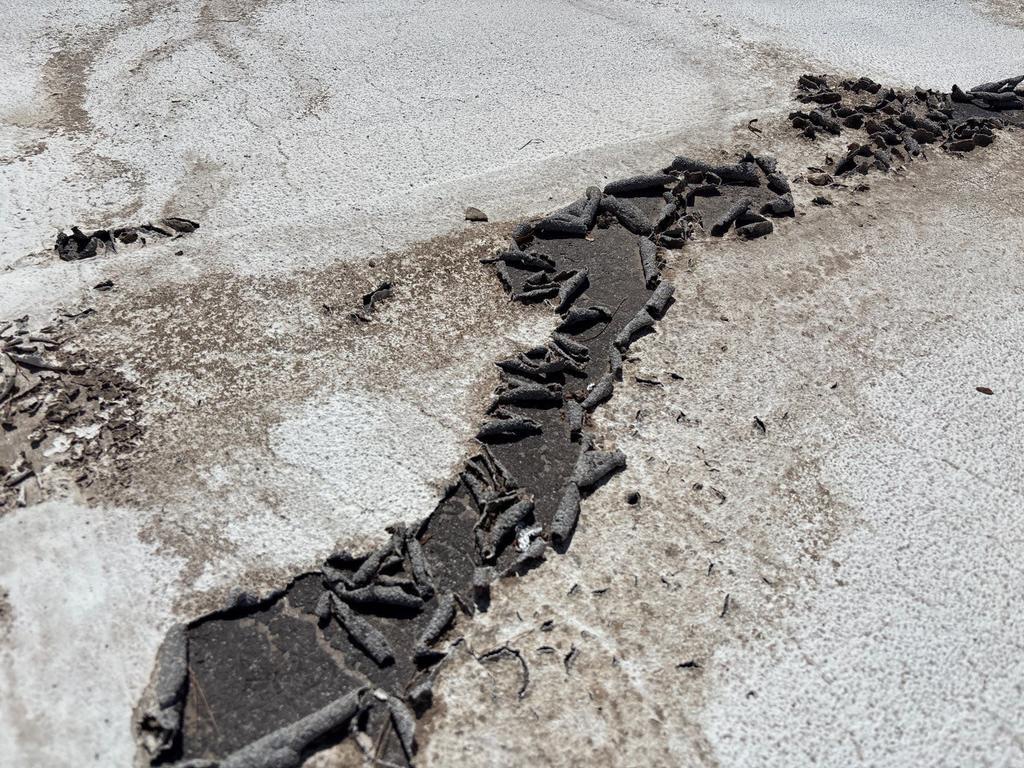
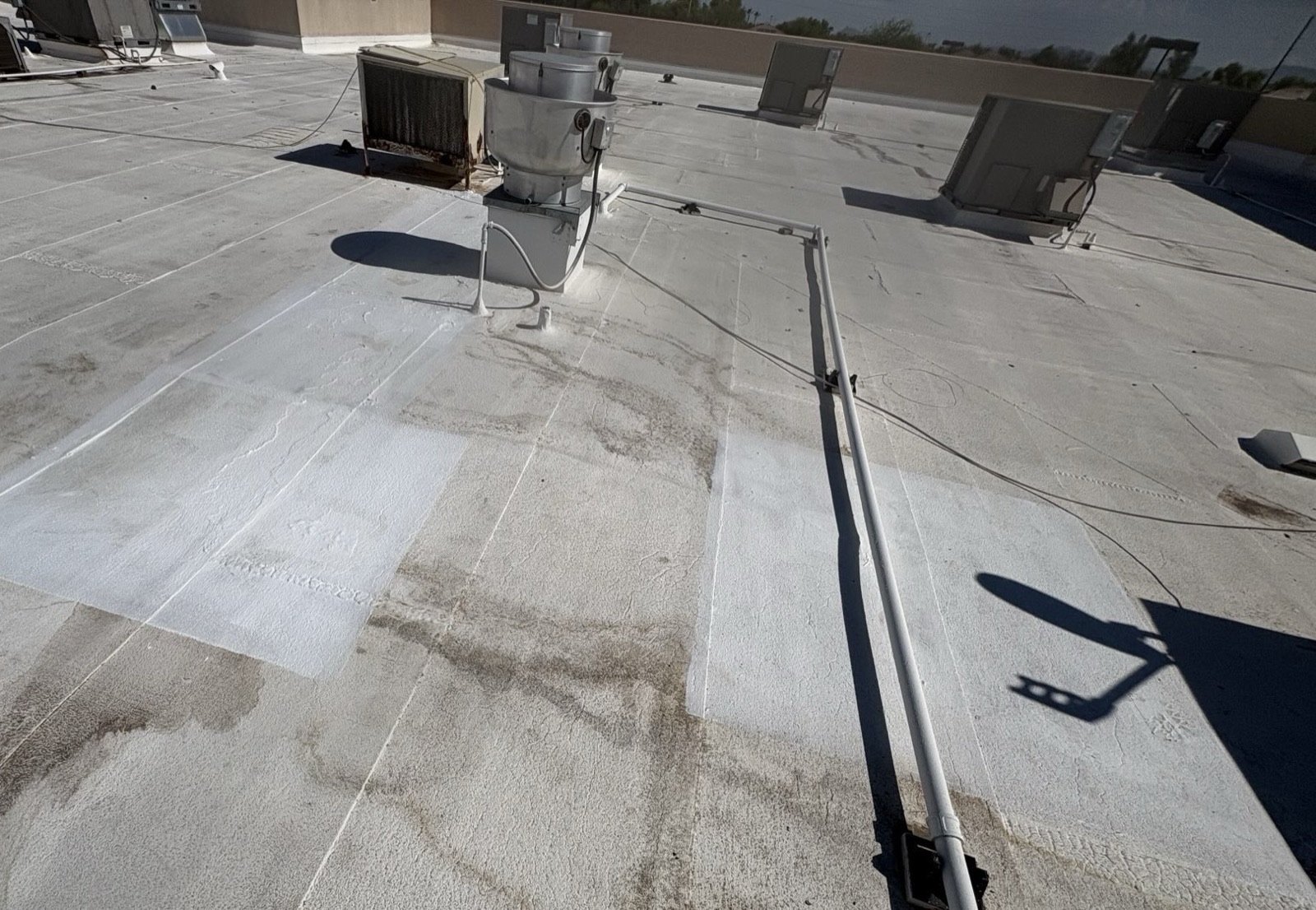
- Peeled and cracked coating across the roof
- Cracking at drains and scuppers
- Failed and cracked prior repairs
- Wear around rooftop equipment
- Debris accumulation
- Areas of coating failure caused by runoff from leaking HVAC units
- Foam blistering in isolated areas
What Was Causing It
On a coated flat roof, the coating is the part that wears out. It is the sacrificial layer that takes the ultraviolet exposure and the water so the built-up cap sheet underneath does not have to. As it ages it thins, gets brittle, and opens up at the places that move most: seams, penetrations, drain sumps, and old repairs. Once it cracks, water gets under the edges and the coating peels away in sheets, which is exactly what we were pulling up by hand on this roof.
The accelerant here was mechanical, not weather. Several rooftop HVAC units were leaking, and their condensate ran across the roof surface continuously rather than draining and drying. Coating that never gets to dry out fails far faster than coating that only sees monsoon season, and the worst areas on this roof mapped directly to the runoff paths below the leaking units.
How We Verified the Roof Condition
The inspection produced a measured roof and a dated written record of its condition, so every option that followed could be priced against the same numbers.
- Walked and photographed the full roof on May 21, 2026, documenting each condition in place
- Measured the roof including one foot up the parapet walls, roughly 18,000 square feet in total
- Produced an aerial roof map of the roof areas so findings could be located from the ground
- Compiled a written inspection report with a photo set and inspection video, delivered to ownership on May 27, 2026
- Reviewed aerial image history to date the last coating application to approximately 2018 to 2019
- Accounted for the two prior leak repairs we had completed at the property
- Priced every option against the same measured area so the three quotes were directly comparable
The report also flagged a condition roofing could not solve: several rooftop HVAC units were leaking, and their runoff was actively degrading the coating. We told ownership those units needed to be repaired before the coating work, because coating applied into standing condensate will not last. That caveat turned out to matter on the day.
The Plan
We priced three scopes against the same measured roof area so ownership could see the trade between what they spent now and how long it would hold.
- Option 1, ten-year elastomeric recoat, $28,288.00 at $1.60 per square foot: full roof cleaning, detailed prep, repairs at penetrations, drains, and scuppers, foam blister repairs, primer as needed, and a three-gallon elastomeric system applied as a base coat and top coat, carried one foot up the parapet walls. Carries a ten-year manufacturer product warranty and a ten-year workmanship warranty, and includes free yearly inspections on request. This was our recommended long-term option.
- Option 2, five-year elastomeric recoat, $22,100.00 at $1.25 per square foot: the same preparation and repair work with a lighter two-gallon single-coat application as a shorter-term restoration. Carries a five-year manufacturer warranty and a five-year workmanship warranty, and includes free yearly inspections on request.
- Option 3, roof maintenance and repairs, $5,304.00 at $0.30 per square foot: targeted work on the isolated problem areas only. Cleaning, crack repairs, sealing failing areas, and touch-up coating at thinning sections, with a two-year limited maintenance warranty on the repaired areas only.
Our written recommendation was Option 1, on the reasoning that the roof was still a good candidate for restoration and that recoating while that was true would extend the life of the system and avoid a premature replacement. Ownership approved Option 3 on May 29, 2026. We reissued the proposal as Option 3 only, submitted the work order, and put it on the schedule.
Materials and Components Used
- Elastomeric Coating: nine gallons total across the two visits, applied over the repaired sections and the areas where the existing coating had thinned
- Primer: one gallon over the scraped and cleaned areas to give the new coating something sound to bond to
- Reinforcing Fabric: six-inch Tytec set into coating for three-course repairs at cracks, roof penetrations, drains, and scuppers
- Sealant: acrylic putty at penetrations and at the areas of thinning and cracking caused by mechanical runoff
- Coverage Detail: the measured and priced area included one foot up the parapet walls, so wall bases were treated as part of the roof rather than trimmed out
- Debris Removal: loose and peeling coating scraped back, and all roof debris bagged and hauled off site
Step-by-Step Work
Work Order, Safety Plan, and Scheduling
The work order went out on June 1, 2026 and the maintenance was scheduled for June 18, confirmed with the property manager in advance so tenants were not surprised by crews on the roof. A written safety plan was completed for the project and followed throughout. Materials came off yard stock, and crews worked without entering any tenant space.
Clean the Roof and Scrape Back Loose Coating
Crews cleared the full roof of dirt and debris accumulation, including the drain areas where debris had collected, and bagged and hauled everything off site. Then the failing coating came off. Anywhere the coating had peeled, curled, or cracked loose it was scraped back to a sound surface, because new material bonded over loose coating simply fails again at the same line.
Dry and Prime the Prepared Areas
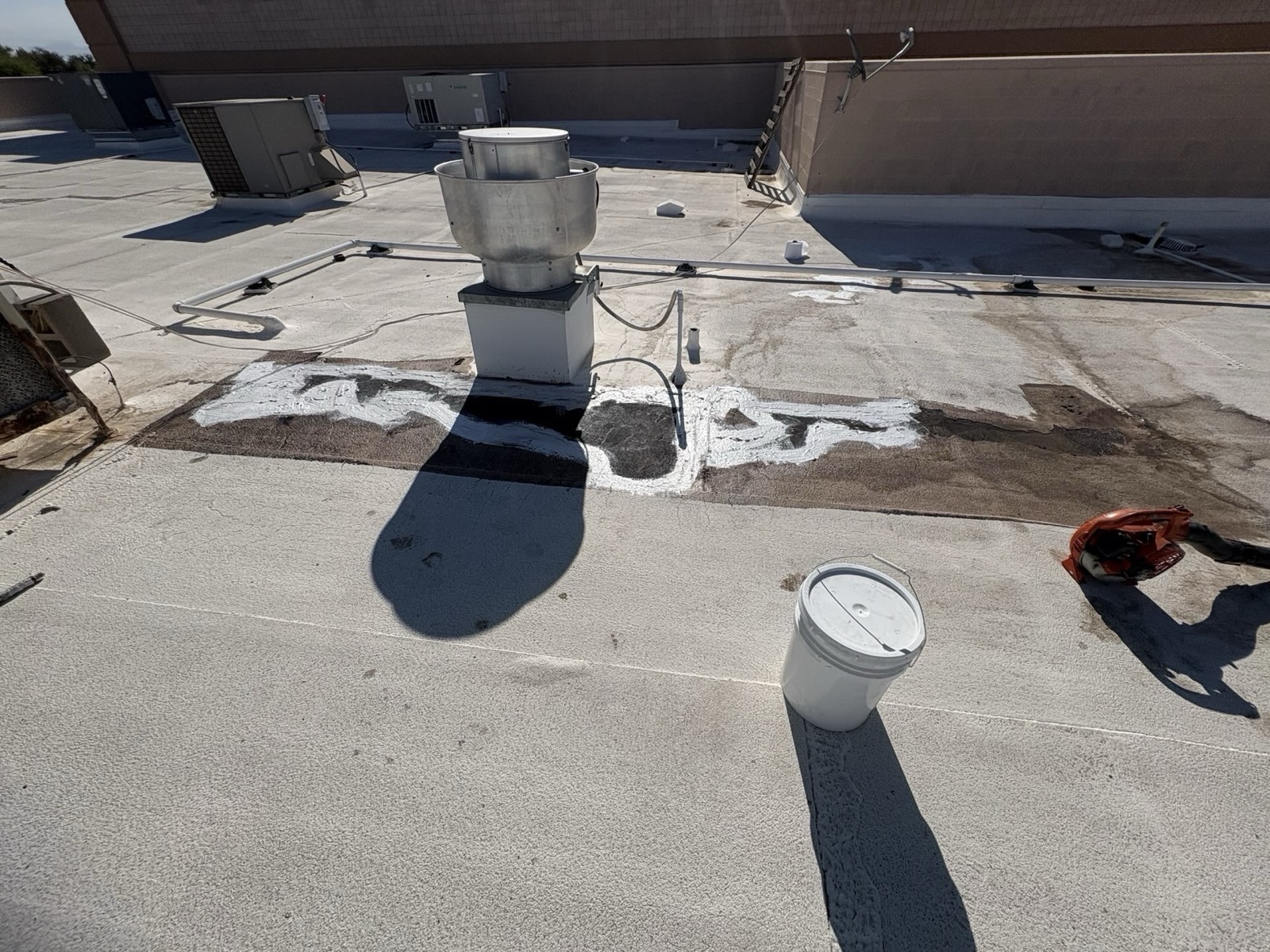
Scraped and cleaned areas were dried and primed to improve adhesion ahead of the coating. One primed area had to be cut short on the spot: an air conditioning unit above it kept dripping onto the surface after the crew had dried and primed it, so rather than coat over a wet substrate the foreman stopped that area and flagged it.
Three-Course Repairs and Sealant at Every Detail
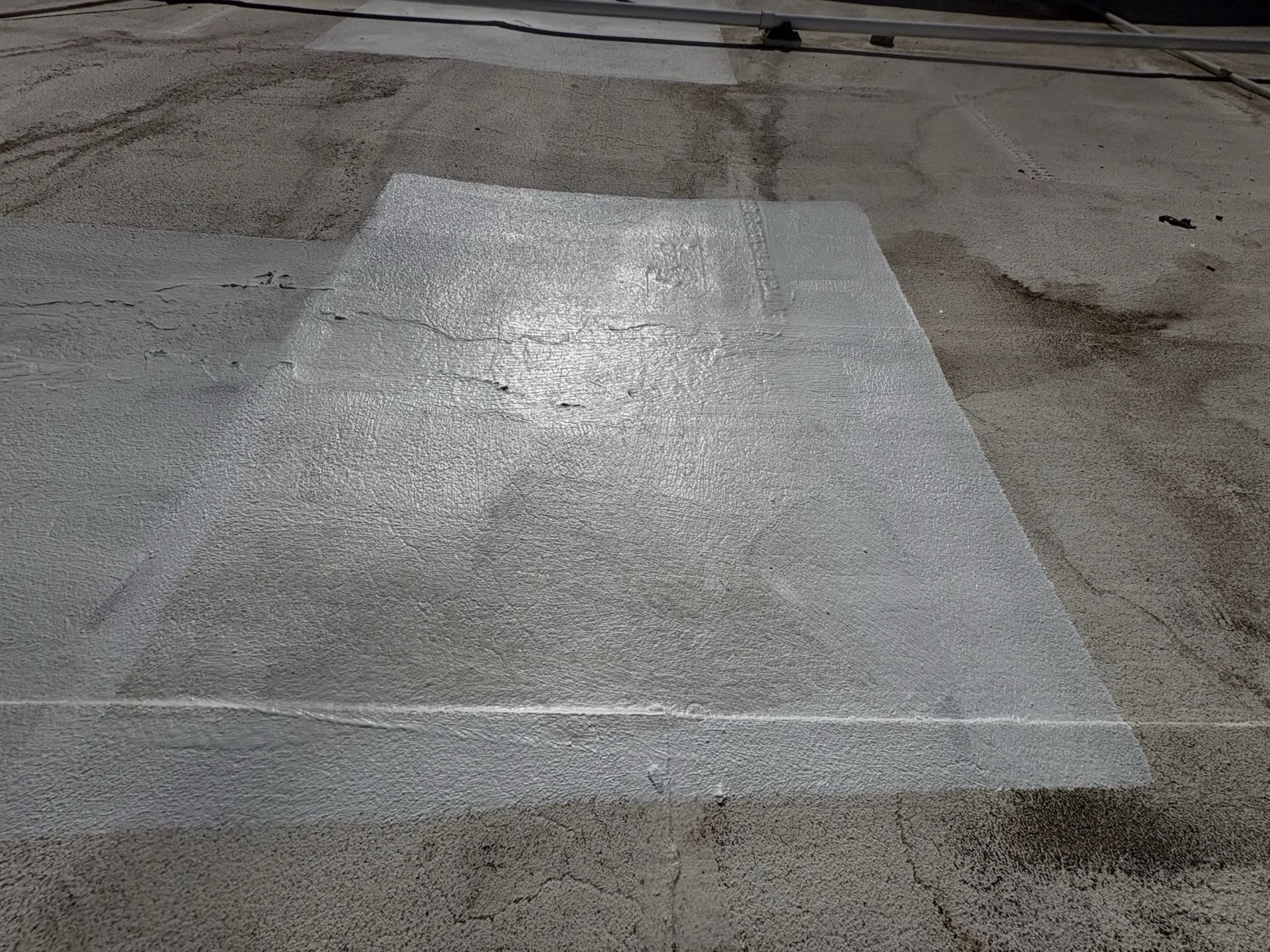
The crew walked the entire roof making spot repairs rather than treating only a short punch list. Cracks at roof penetrations, drains, and scuppers received three-course repairs, with six-inch reinforcing fabric bedded into coating and coated over. Acrylic putty sealant went into the areas of thinning and cracking caused by mechanical runoff and around penetrations and rooftop equipment.
Coat the Thinning Areas, Then Return to Finish
Elastomeric coating went over the repaired sections and the thinning areas, and work areas were cleaned with all debris hauled away. Most of the roof was completed on June 18. The areas sitting under the leaking mechanical units could not be finished, so we sent ownership an aerial marking exactly which unit was still leaking and held those areas open. Once ownership’s mechanical contractor had repaired the units, we returned on June 25 and completed the remaining work.
Results
The approved scope was completed across two visits in June 2026, most of it on June 18 and the remainder on June 25 once the leaking mechanical units had been repaired by ownership’s contractor. The approved total of $5,304.00 held with no change orders.
The approved scope carried a 2 Year Warranty On Repairs: a two-year limited maintenance warranty covering the repaired areas only, running through June 18, 2028. The recoat options carried broader coverage. Option 1 would have carried a ten-year manufacturer product warranty plus a ten-year workmanship warranty, and Option 2 a five-year pair, both including free yearly inspections at the owner’s request. A maintenance scope warrants the work performed, not the areas nobody touched. The exclusion that matters most on this roof sits outside roofing entirely: runoff from leaking rooftop HVAC units will keep destroying coating, so those units have to stay repaired, and the drains have to stay clear, for any coating work to reach its expected life.
Before and After
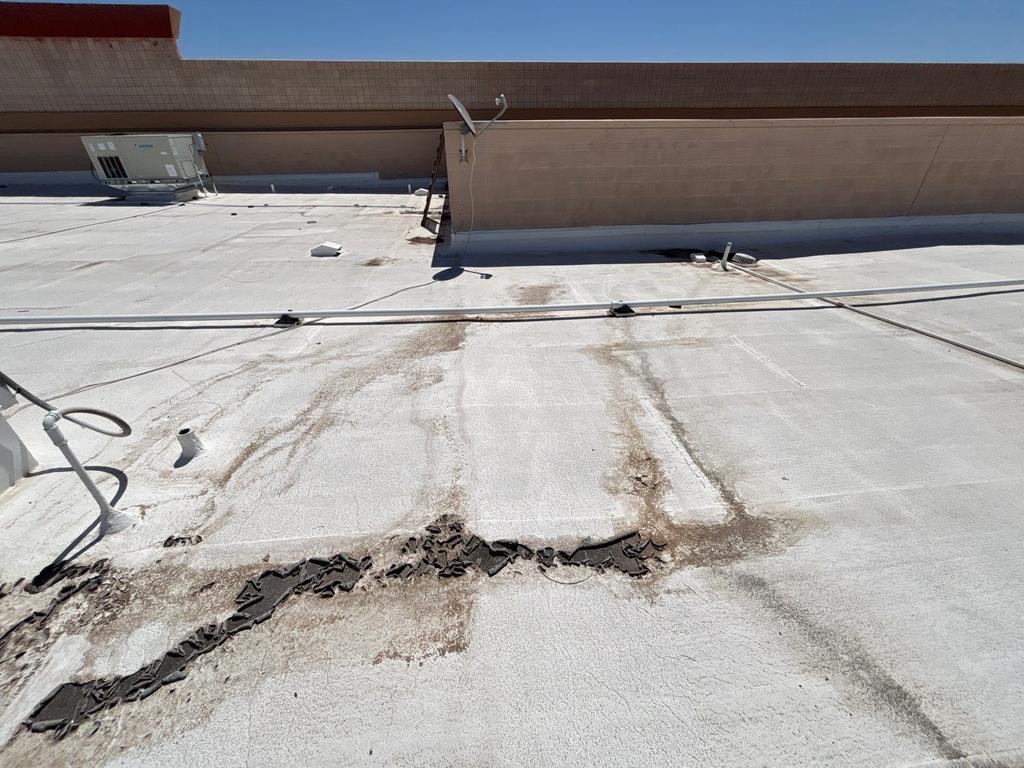
A side-by-side recap of the roof field as we documented it during the evaluation, and the same kind of area after the approved repairs and coating went in.
FAQ
What does a commercial roof evaluation actually produce?
On this property it produced a measured roof and a dated written record. We walked and photographed the full roof, measured it including one foot up the parapet walls to arrive at roughly 18,000 square feet, built an aerial roof map so findings could be located from the ground, shot an inspection video, and delivered a written inspection report with the photo set. Seven specific conditions were listed, from peeled and cracked coating to foam blistering in isolated areas. Then every repair option was priced against that same measured area so the quotes could be compared line for line.
Why price three options instead of just making one recommendation?
Because the roofing decision and the budget decision are not the same decision. We did make a recommendation, Option 1, the ten-year recoat at $28,288, on the reasoning that the roof was still a good candidate for restoration. But an owner managing a retail property has to weigh that against what is available this year. Pricing a ten-year recoat at $28,288, a five-year recoat at $22,100, and targeted maintenance at $5,304 against the same measured area let ownership choose the tier that fit and keep the other two costed. They approved the maintenance option, and the recoat numbers are still on file for a future budget cycle.
Why was maintenance only $0.30 per square foot when the recoat was $1.60?
Scope, and the warranty tells you where the line is. At $0.30 per square foot the maintenance option buys cleaning, crack repairs at penetrations, drains, and scuppers, sealant at the failing areas, and touch-up coating where the existing coating had thinned. It is targeted at the isolated problem areas. At $1.60 per square foot the recoat buys all of that preparation plus foam blister repairs, primer, and a full three-gallon elastomeric system applied as a base coat and a top coat across the entire roof. That is why one carries a two-year warranty on the repaired areas only and the other carries ten-year product and workmanship warranties on the whole system.
Why did the work need two visits?
Leaking rooftop HVAC units. Our inspection report had already warned that the leaking units needed to be addressed before coating work, because their runoff was what damaged the coating in the first place and coating will not cure or bond into standing condensate. On June 18 the crew completed most of the roof, but one area had to be stopped after it was dried and primed because a unit above kept dripping onto it. We sent ownership an aerial marking the leaking unit, ownership had the condensation repairs done, and we returned on June 25 to finish the remaining areas rather than coat over a problem we knew would come back.
What does a two year warranty on repairs actually cover?
It covers the areas we repaired, and it runs through June 18, 2028. It is a limited maintenance warranty, which means it warrants the work performed rather than the whole roof. A recoat is what buys system-wide coverage: Option 1 carried a ten-year manufacturer product warranty plus a ten-year workmanship warranty and free yearly inspections on request. On a maintenance scope the owner’s side of the bargain also matters. Keep the drains clear, and keep the rooftop mechanical units from leaking onto the roof, because that runoff is what shortened the coating’s life here to begin with.
Have more questions? Check out our FAQ page.
Need a Documented Roof Evaluation for a Commercial Property in the Phoenix Metro?
If you manage retail, office, or industrial property and you are making roof decisions without a measured roof area or a dated condition report, request a commercial roof inspection. We will document the conditions in place, measure the roof, and price your realistic options against that same area, so you can see what each tier costs before you approve anything.
Five Guys Roofing · (480) 892-5311 · ROC# 301077 & ROC# 301076 · fiveguysroofing.com
We do not publish addresses, property names, or client-identifying details.
