
Commercial Foam Roof Replacement • Peoria, Arizona • First Phase of an Ongoing, Building-by-Building Program • Completed by Five Guys Roofing
Peoria Commercial Foam Roof Replacement: Scarifying and Rebuilding Six Occupied Buildings as the First Phase of an Ongoing Program
Five Guys Roofing completed the first phase of an ongoing foam roof replacement for a Peoria multi-building townhome community, working one building at a time so no resident lost access to their home. Some details have been generalized to protect the property owner’s privacy, while keeping the scope, materials, and phasing clear.
City
Peoria, AZ
Property Type
Multi-building townhome community, one and two story
Roof System
Sprayed polyurethane foam, scarified and rebuilt
Service
Commercial foam roof replacement, phased
Scale
First phase: 6 buildings, 48 units
Warranty
10 Year Warranty
Pricing and What Drives It
Approved first phase total: $202,908.40. The full program covering the whole property comes to $471,880. The main cost drivers were the decision to scarify and rebuild rather than recoat, the number of buildings that needed the full rebuild versus a lighter recoat, 23 curb-mount skylight replacements, the volume of hand detailing at penetrations and mechanical units, and the productivity cost of working one building at a time on an occupied site.
Typical published range for commercial foam roofing on a property like this: roughly $1.70 per square foot where the existing foam can be washed and recoated, up to $4.50 per square foot where it has to be scarified and rebuilt with new foam and a two-coat system.
The Situation
The property came to Five Guys Roofing for a general roof inspection with overall condition and recommendations across a community of one- and two-story flat-roofed buildings. The foam roofing was more than 15 years old, and the elastomeric coating that protects it had worn through over large stretches of roof. The scope that came out of that inspection was not a recoat. Most of these roofs needed the old foam taken down and a new foam layer sprayed on.
- A foam roof system more than 15 years old across the community
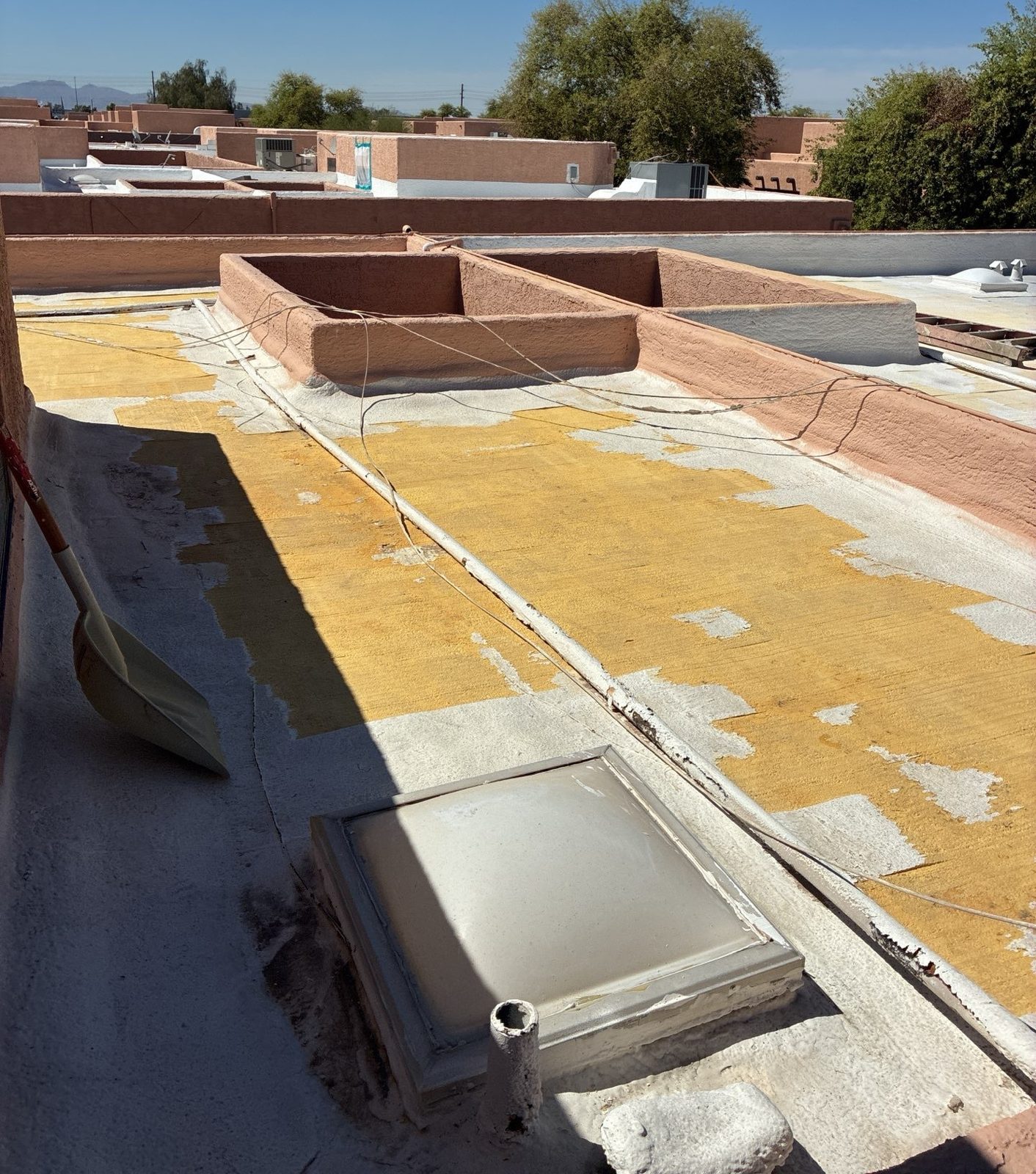
- Coating worn away in large areas, leaving oxidized foam directly exposed
- Foam degraded deeply enough that a surface recoat would not have lasted
- Aging curb-mount skylights and penetration details throughout
- A budget that had to be spread across phases rather than spent all at once
What Was Causing It
Foam roofing lasts a long time in Arizona, but only while the coating over it holds. Once the coating thins and opens up, ultraviolet exposure attacks the foam directly. It oxidizes, turns yellow and friable, and loses its surface integrity. At that point a wash and recoat has nothing sound to bond to. On most of these buildings the degradation had gone far enough that the correct fix was to scarify the compromised top layer off and rebuild the foam thickness from new material.
How We Verified the Roof Condition
We inspected the roofs and separated the property into two treatment categories. That split is what made a phased program possible: the owner could see which buildings needed the expensive rebuild and which only needed a recoat, and budget accordingly.
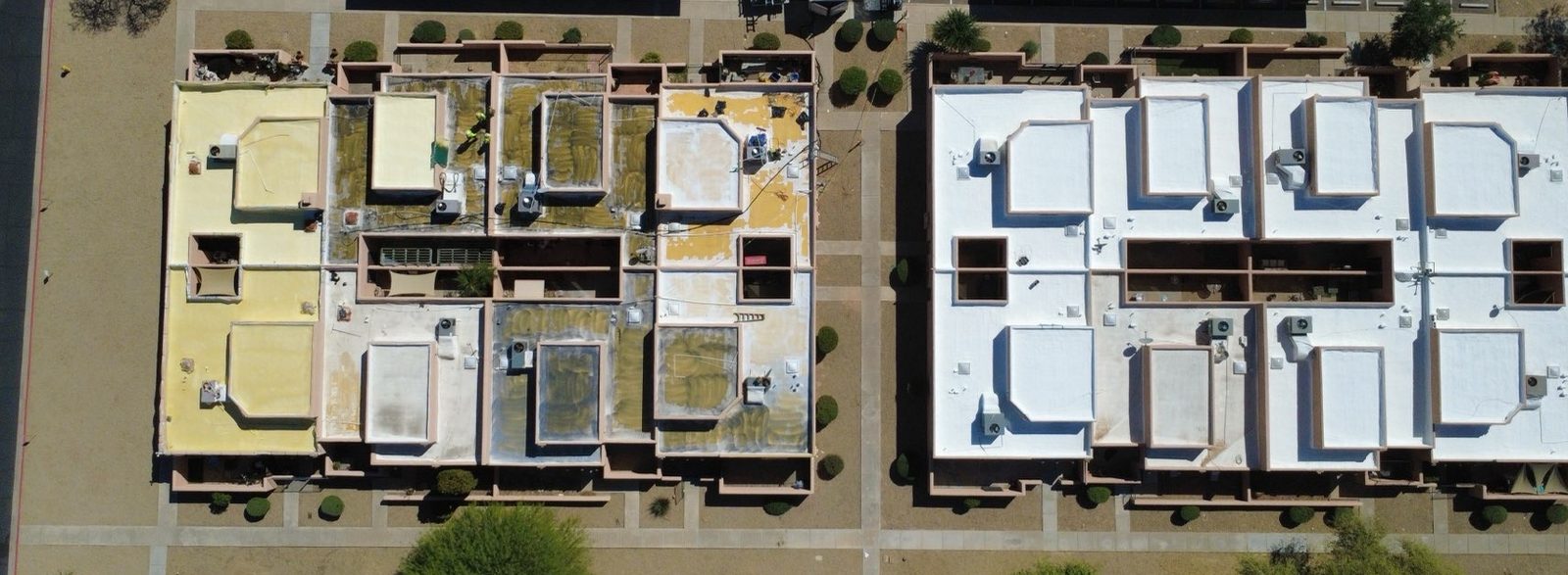
- Documented condition across the community, including aerial mapping of the roof areas
- Identified roughly 93,000 square feet needing scarify plus one inch of new foam plus a 3-gallon coating system, at $4.50 per square foot
- Identified about 24,000 square feet where the existing foam was sound enough for a wash, foam repairs, and a 3-gallon recoat
- Counted 23 curb-mount skylights for replacement, 21 reusing the existing curb and 2 requiring a new curb built from 2×10 framing
- Confirmed the constraint that crews could only work on one building at a time, and set a pre-job walk to get a building-by-building map
One area was revised during the work: a change order upgraded 1,313 square feet from scarify preparation to a full tear-off and disposal of an existing cap sheet layer once crews got into it.
The Plan
The plan was to run a complete rebuild cycle on one building, finish it, walk it, sign it off, and only then move to the next. That is slower than mobilizing across a whole property at once, but on an occupied community it means one building’s residents are affected at a time and the property always has a finished, warrantied roof behind the crew. The first phase committed to six buildings; the remainder was scheduled into later phases.
Materials and Components Used
- New Foam: 1,787 gallons of closed-cell polyurethane roofing foam, sprayed at one inch thickness with extra build over low areas and low cricket locations
- Primer: 233 gallons applied over the scarified substrate at 0.25 gallons per 100 square feet to improve adhesion
- Coating: 3,522 gallons of white elastomeric, applied as a base coat and top coat at 1.5 gallons per 100 square feet each
- Reinforcing Fabric: Tytek in 6 inch, 12 inch, and 40 inch widths for three-course repairs at drains, scuppers, and cracks
- Sealant: 14 buckets of Tropical acrylic putty at penetrations, plus Chemlink caulking over loose or cracked joints on parapet wall flashings
- Skylights: 23 curb-mount skylight units, with 2x10x16 framing for the two curbs that had to be rebuilt and foam-sealed
- Coverage Detail: Foam and coating both carried one foot up the parapet walls and detailed at every penetration, AC unit, and edge
Step-by-Step Work
Pre-Job Walk, Safety Plan, and Occupied-Site Setup
We held a pre-job walk before the first building to map the sequence and agree staging. A written safety plan was completed for the project and all safety measures were followed throughout. Parking was blocked off in specific areas for safety, a dumpster was set on site for roof debris, and crews used car covers to protect residents’ vehicles from overspray.
Scarify the Existing Foam and Clear the Deck
A scarify machine took the top quarter to half inch of degraded foam off the roof, and all debris was hauled away. With the surface opened up we inspected for soft areas and flagged any concerns to the customer before proceeding. On one 1,313 square foot area this step was upgraded by change order to a full tear-off and disposal of an existing cap sheet layer.
Prime, Mask, and Coordinate Rooftop Obstructions
We primed the substrate at 0.25 gallons per 100 square feet to improve adhesion, then masked and prepared walls, transitions, and affected areas ahead of the foam. Satellite dishes sitting on the roof deck were lifted so foam could go underneath them, with realignment left to the residents’ service providers. Non-curb-mounted mechanical units were detached and reset by the property’s own mechanical vendor so we could foam and flash properly beneath them. Areas without full access are a standard exclusion on this kind of warranty.
Spray One Inch of New Closed-Cell Foam
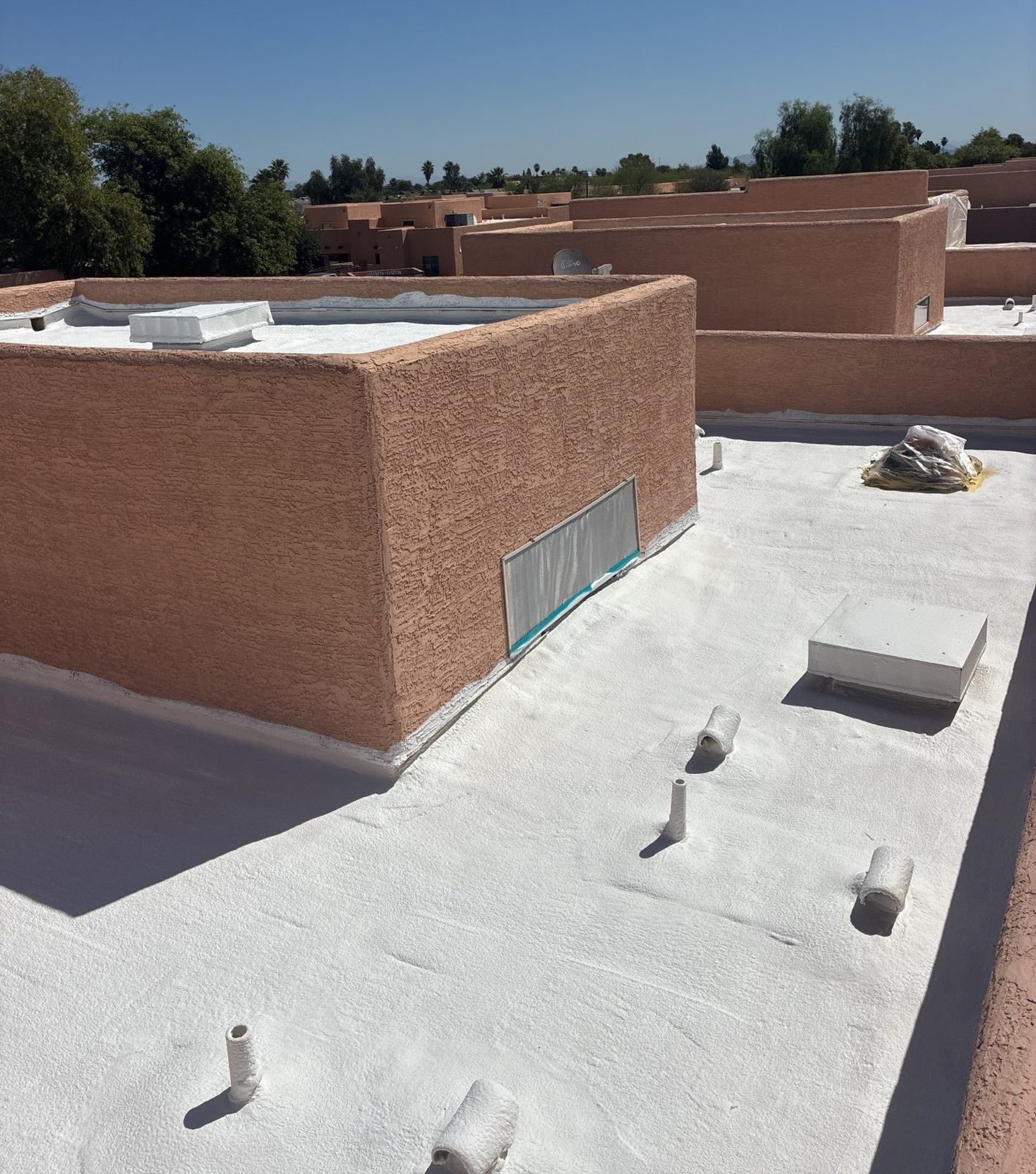
Closed-cell polyurethane roofing foam went down at a one inch thickness, with additional build over low areas and low cricket locations so water would move to drainage. Foam was detailed at all roof penetrations, AC units, edges, and parapet walls, and carried one foot up the parapets. This is the step that restores both the waterproofing and the insulation value of the assembly.
Two-Coat Elastomeric, Skylights, and Per-Building Sign-Off
A white elastomeric base coat and top coat followed at 1.5 gallons per 100 square feet each, detailed around penetrations, edges, and parapet walls and carried one foot up the parapets. Roof drain covers were reinstalled, curb-mount skylights were replaced, and work areas were cleaned with project debris hauled away. Each building then received a quality walk, a touch-up pass, and a final walk before crews moved on. AC condensation lines found disconnected during the walks were reconnected.
Results
The first phase delivered six complete buildings, eight units each, for 48 units in total. On-site production ran from early March to late April 2026, with each building taking roughly one to two weeks from first mobilization to final walk. Every building was finished and signed off before the next one started, and no resident had to relocate at any point.
The approved scope carried a 10 Year Warranty: a 10-year product warranty from the foam and coating manufacturer plus a 10-year installer warranty from Five Guys Roofing. Replacement skylights carried a 2-year warranty on the repair. Standard exclusions apply, including areas beneath non-curb-mounted mechanical equipment where full access is not available, penetrations or equipment installed or serviced by others after completion, storm-related events, damage from other trades or foot traffic, and lack of routine maintenance such as keeping drains clear.
Before and After
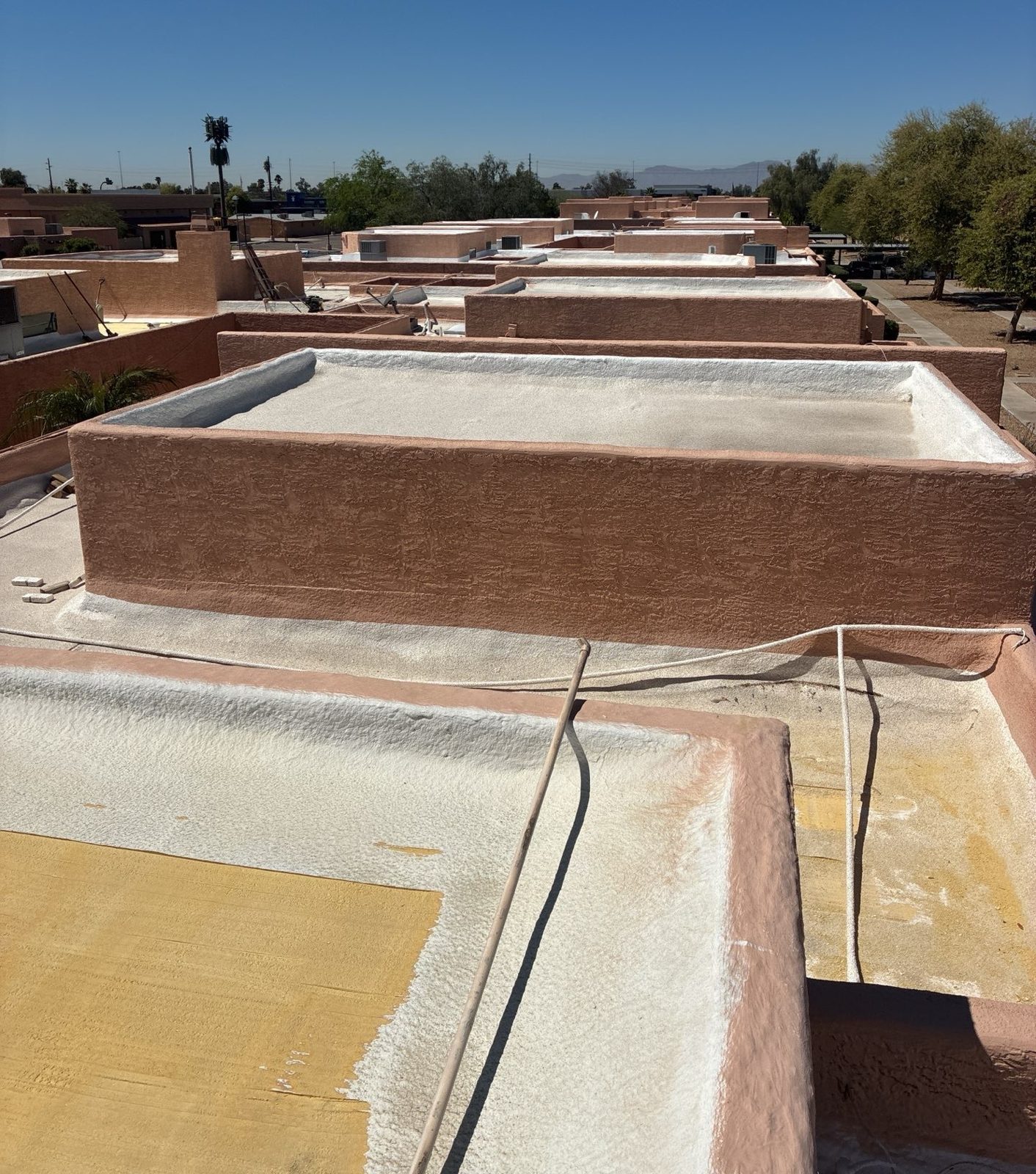
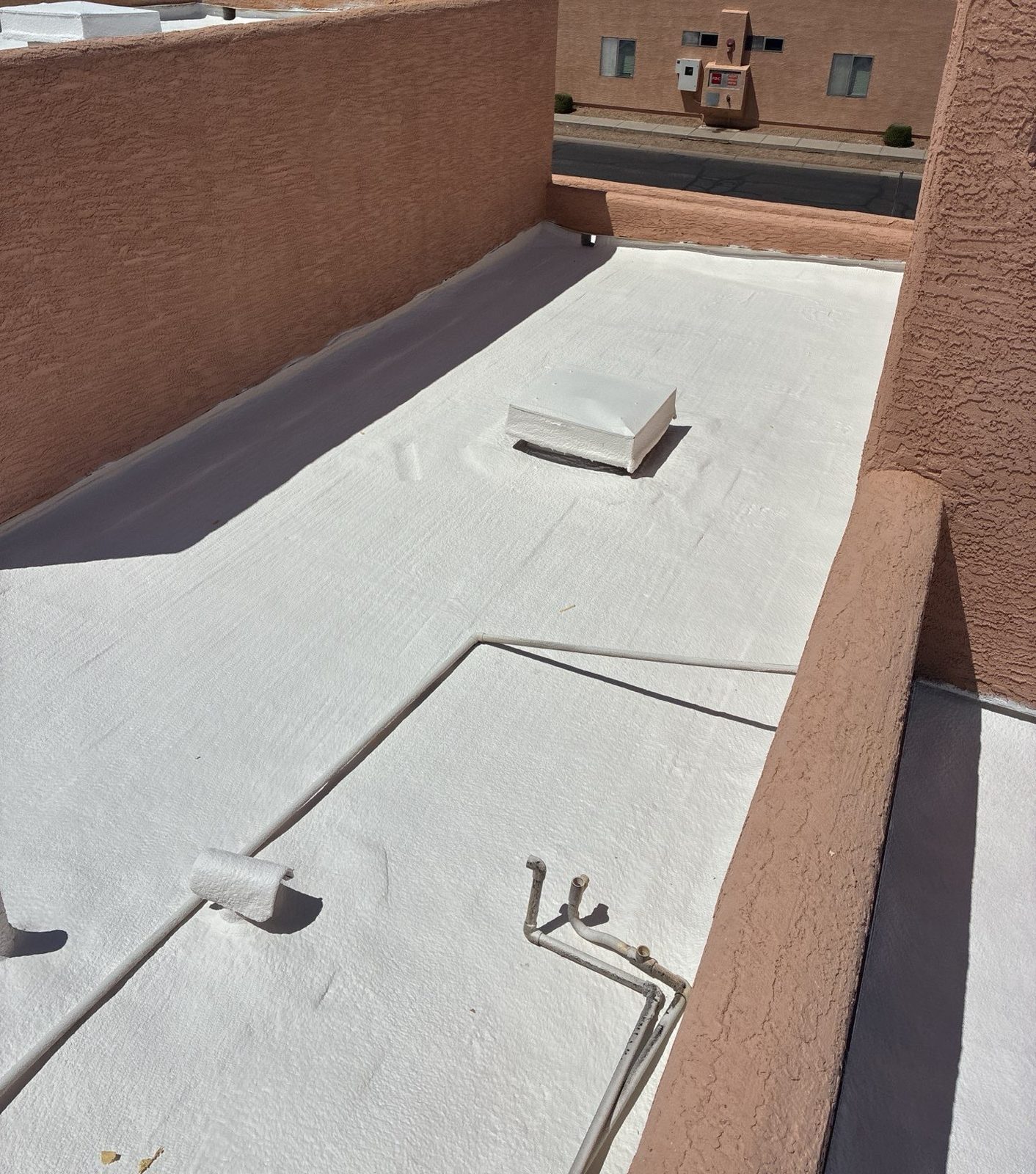
A side-by-side recap of a roof with its coating worn off and exposed foam, and the rebuilt foam-and-coating assembly that replaced it.
FAQ
Why phase a roofing project instead of doing the whole property at once?
Two reasons, and on this property both applied. Budget is the obvious one: this first phase was part of a $471,880 program across the property, which let the owner spread the work over more than one budget cycle instead of one capital outlay. The second is occupancy. Working one building at a time means one building’s residents deal with crews, noise, and parking changes at a time, and every completed building is finished, walked, and under warranty before the next one opens up.
How much disruption should residents and tenants expect?
The disruptive phases are scarifying, which is noisy and generates debris, and spraying, which requires masking and overspray control. Both happen on the roof of the building being worked. Parking gets blocked off in specific areas for safety, a dumpster sits on site for roof debris, and crews use car covers to protect residents’ vehicles. Rooftop items belonging to residents, such as satellite dishes and AC condensation lines, are lifted or detached and then handled and put back.
What is the difference between a foam recoat and a foam replacement, and how do you decide?
A recoat washes the existing foam, repairs blisters and ponding areas, and applies a new coating on top. A replacement scarifies the degraded top layer of foam off and sprays new foam before coating. The deciding factor is whether the existing foam is still sound enough to bond to. On this property we split it: roughly 93,000 square feet needed the full scarify-and-rebuild at $4.50 per square foot, while about 24,000 square feet was sound enough for a wash, foam repairs, and recoat.
What drove the cost on this phase?
This phase was $202,908.40. The biggest driver was the scarify-and-rebuild scope, which costs materially more per square foot than a recoat because it adds machine work, debris disposal, priming, and a full inch of new foam. On top of that were 23 curb-mount skylight replacements, hand detailing at every penetration and mechanical unit, and the reduced productivity of a one-building-at-a-time sequence on an occupied site. One change order added a cap sheet tear-off on 1,313 square feet once crews opened that area up.
What warranty came with it, and what would void it?
A 10 Year Warranty: a 10-year manufacturer product warranty plus a 10-year installer warranty from Five Guys Roofing, with a 2-year warranty on the replacement skylights. The exclusions worth planning around are the ones a property manager controls: keep the drains clear and keep up scheduled maintenance, and have any new rooftop equipment or penetrations installed with the roofing coordinated so the foam and coating get detailed back in. Areas under non-curb-mounted mechanical equipment that cannot be fully accessed are excluded, which is exactly why we had those units detached and reset during the work.
Have more questions? Check out our FAQ page.
Planning a Phased Roof Program in the Phoenix Metro?
If you manage a multi-building commercial, HOA, or multifamily property and need the roofs replaced across more than one budget cycle, request a commercial roof inspection. We will document condition building by building, separate what needs a full rebuild from what only needs a recoat, and lay the phases out with real numbers so your board or ownership group can approve the work in stages.
Five Guys Roofing · (480) 892-5311 · ROC# 301077 & ROC# 301076 · fiveguysroofing.com
We do not publish addresses, property names, or client-identifying details.
