
Commercial Cap Sheet Roof Restoration • Phoenix, Arizona • About 215,000 Sq Ft Across Ten Occupied Retail Buildings • Completed by Five Guys Roofing
Phoenix Commercial Cap Sheet Roof Restoration: Recoating About 215,000 Square Feet of Built-Up Roofing Across Ten Occupied Retail Buildings
Five Guys Roofing restored the aging built-up cap sheet roofs on ten buildings at a Phoenix open-air retail center, keeping every store open while crews worked overhead. Some details have been generalized to protect the property owner’s privacy, while keeping the scope, materials, and measured areas clear.
City
Phoenix, AZ
Property Type
Open-air retail center, ten one-story buildings
Roof System
Built-up cap sheet, restored in place
Service
Commercial cap sheet roof restoration and recoat
Scale
About 215,000 sq ft across 10 buildings
Warranty
10 Year Warranty
Pricing and What Drives It
Approved total: $485,055. That broke into $467,808 for the restoration scope and a separate $17,247 line for manufacturer No-Dollar-Limit warranty coverage. The main cost drivers were sheer measured area, the roughly 6,200 linear feet of parapet the coating had to be carried up, the volume of hand detailing at split seams and penetrations, about 20,000 square feet of shingled parapet wall that needed foam before coating, stripping and hauling away every walk pad on all ten roofs, and working around live retail tenants and rooftop equipment.
Priced at $2.25 per square foot all in: $2.17 per square foot for the restoration itself, plus $0.08 per square foot for the manufacturer NDL warranty line.
The Situation
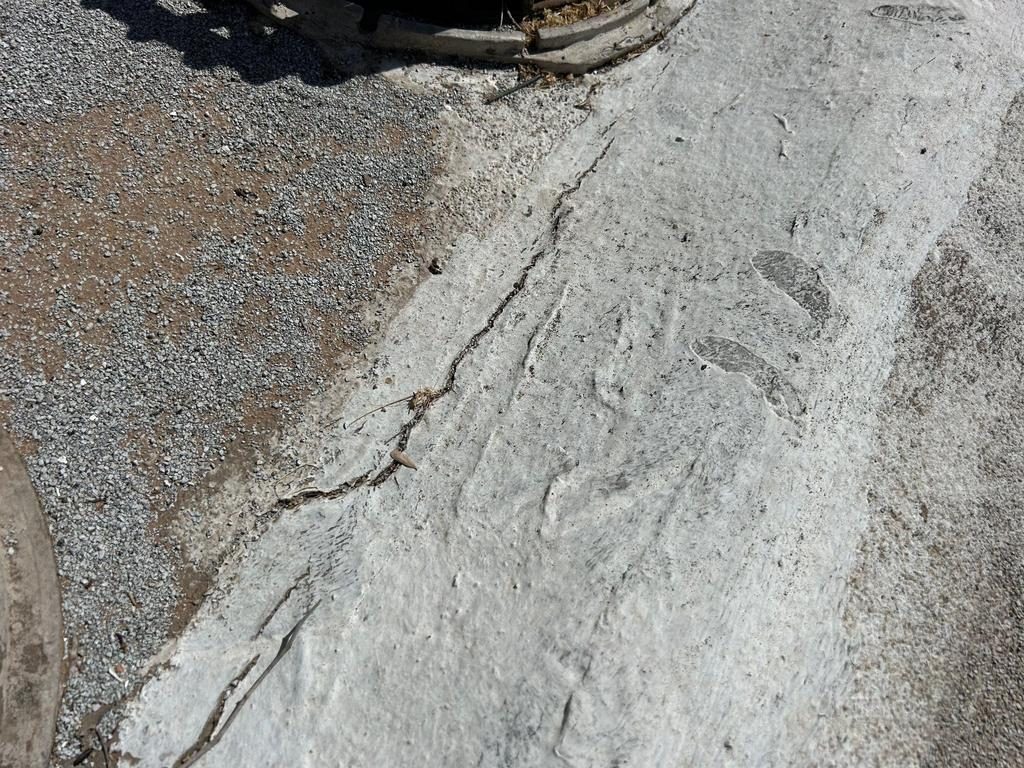
The property came to Five Guys Roofing for a general roof inspection with overall condition and recommendations across a strip of ten single-story flat-roofed buildings. The roofs were granulated built-up cap sheet, more than 15 years old, and they had reached the point where the surfacing was no longer doing its job. The question in front of ownership was not whether to spend money on these roofs. It was whether the plies underneath were still sound enough to restore, or whether ten buildings were headed for tear-off.
- A built-up cap sheet system more than 15 years old across all ten buildings
- Split and open seams running through ridged areas of the cap sheet
- Alligator cracking and granule loss in the field and at wall transitions
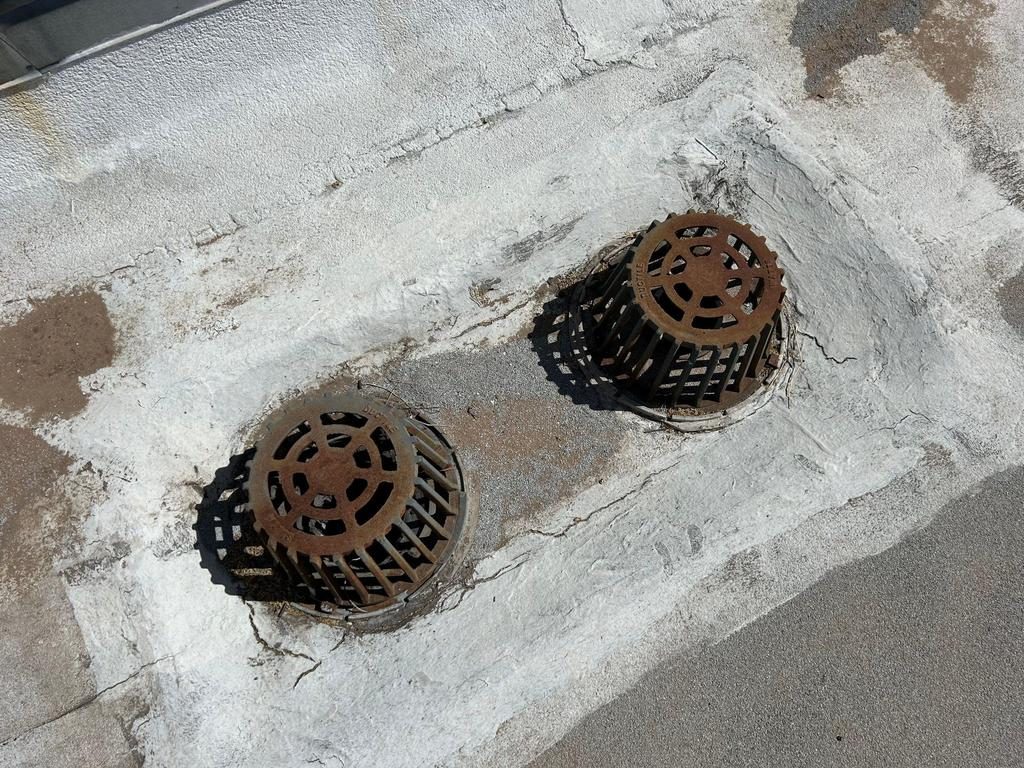
- Rusted drain assemblies sitting in ponding areas patched over with layers of old mastic
- Aging walk pads across every roof, trapping dirt and hiding the surface beneath them
- Live retail tenants underneath, so no roof could be left open
What Was Causing It
Built-up roofing earns its keep through redundancy. Multiple reinforcing plies are bonded into one thick assembly and finished with a granulated cap sheet that takes the foot traffic a single-ply membrane cannot. What wears out first is that cap sheet surface, not the plies below it. In Phoenix the granules erode, the asphalt below them oxidizes and goes brittle, and thermal cycling opens the laps and the ridged areas where sheets overlap. That is what we found here: a surface at the end of its service life sitting on plies that were still dry and sound. When that is the picture, coating is the correct answer, and a tear-off would have thrown away most of a roof that still worked.
How We Verified the Roof Condition
We inspected and photo-documented all ten buildings and measured the property rather than estimating it, because on a job this size the measured area is what the price is built from. The inspection also had to satisfy a second audience: the owner retained an independent roof consultant on this project, so our findings and our proposed system had to hold up to outside review.
- Documented condition building by building, with a photo-backed inspection report and aerial mapping of the roof areas
- Measured about 209,000 square feet of roof deck plus roughly 6,200 linear feet of parapet, for about 215,000 square feet including one foot up the parapet walls
- Confirmed the plies were sound enough to restore, so the scope was written as a coating restoration rather than a tear-off
- Identified about 20,000 square feet of shingled parapet wall that needed one inch of sprayed foam before it could be coated
- Identified low ponding areas needing build-up, split seams needing three-course repair, and existing silicone areas that would have to be tied back into the new acrylic
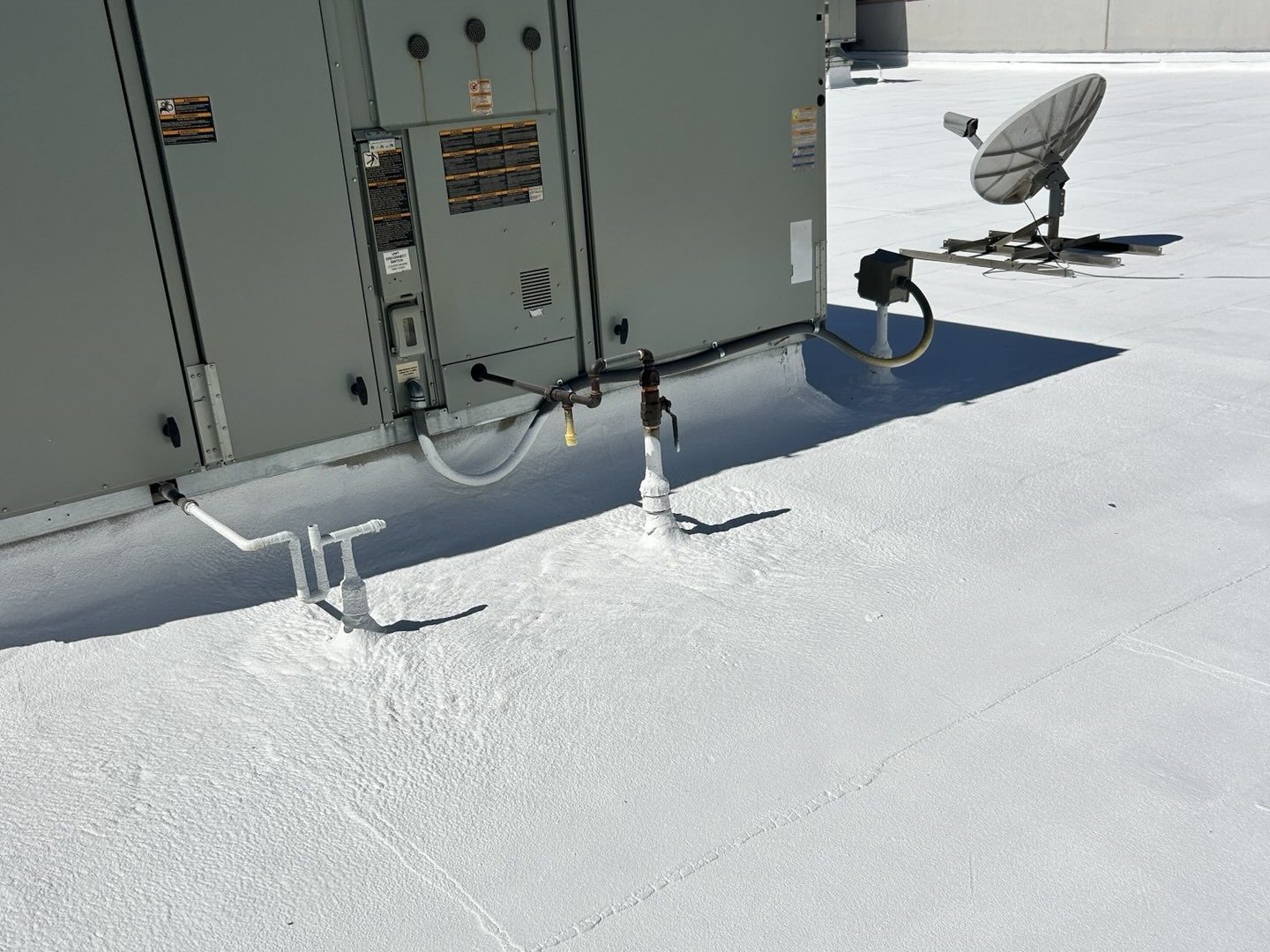
- Flagged rooftop equipment that needed silicone rather than acrylic for six feet out from each unit
This was one phase of an ongoing program on the property. Earlier phases had already restored other buildings, so ownership had a track record on the same roof type before approving this scope.
The Plan
The plan was to treat the existing cap sheet as the base layer of a new assembly instead of as waste. Wash it back to a sound surface, remove everything sitting on top of it, repair every opening by hand, then build a reinforced acrylic system over the whole roof and one foot up every parapet. Sequencing ran building by building so tenants below stayed open and no roof was ever left open overnight. The scope was written for 74 planned crew days on site across wash, walk-pad removal, priming, foam, and coating.
Materials and Components Used
- Clear Base: Metacrylics Acrylic Clear Base at 1 gallon per square, over the entire roof deck plus one foot up the parapet walls, flashings, and HVAC ducting, allowed 4 to 12 hours to cure
- Top Coats: Metacrylics Acrylic White at 3 gallons per square total, applied in two passes of 1.5 gallons per square each with 24 to 48 hours between them, back rolled
- Reinforcing Fabric: Embedded and saturated at drains and split seams, with 40-inch fabric run around the roof drains
- Three-Course Detailing: Fabric and mastic at every penetration, at splitting seams, and at all roof-to-sidewall joints, per manufacturer requirements
- Sprayed Foam: One inch of SPF over the shingled parapet walls before coating, plus build-up at low ponding areas to move water toward the drains
- Silicone: Over existing silicone areas, tied back into the acrylic, and six feet out from the rooftop equipment that needed it
- Coverage Detail: All coping seams sealed, and coating carried one foot up the parapet walls across the roughly 6,200 linear feet of parapet
Step-by-Step Work
Pre-Job Walk and Occupied-Site Setup
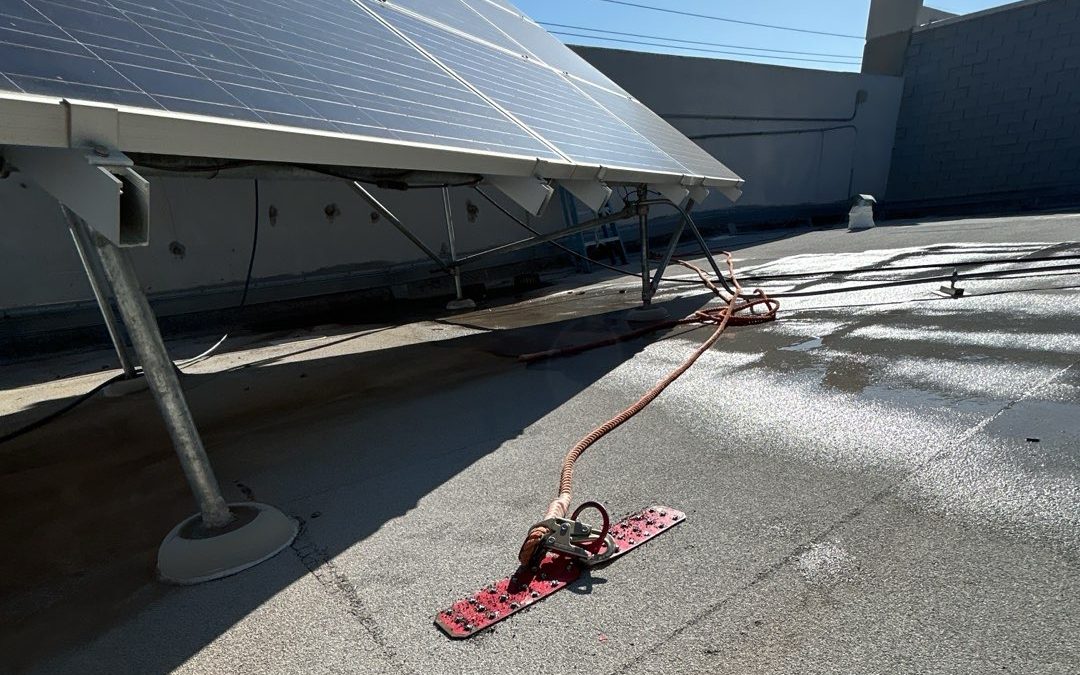
We held a pre-job walk with the owner’s roof consultant before mobilizing, to agree the sequence across the ten buildings. Access was arranged with property management ahead of each shift. A portable restroom and a dump trailer were set on site, and all safety measures were followed throughout the project.
Pressure Wash Every Roof and Strip the Walk Pads
The scope allowed 16 crew days for washing, and it needed them. Crews pressure washed the existing cap sheet on all ten buildings, removed dirt and debris build-up, cleared the drains at the base of each building, and hauled the debris away. Every walk pad on the property came out, including the pads ringing each rooftop air handling unit. There were enough bagged pads to need a dedicated dump trailer to clear them.
Repair by Hand, Then Prime with Clear Base
With the surface clean we three-coursed every splitting seam, every penetration, and every roof-to-sidewall joint with fabric and mastic, and ran 40-inch fabric around the roof drains. Low ponding areas were built up with sprayed foam so water would move to the drains rather than stand. Metacrylics Acrylic Clear Base then went down at one gallon per square, saturating and encapsulating the fabric at drains and split seams, and it was given 4 to 12 hours to cure before anything else touched it.
Foam the Shingled Parapets and Coat in Two Passes
The shingled sections of parapet wall were masked and sprayed with one inch of foam so they could be coated as part of the same system. Masking those walls and the air handling units around them was the slowest part of the foam work, and one day of spraying had to be pulled off entirely because of wind. White acrylic then went on in two separate passes of 1.5 gallons per square, back rolled, with 24 to 48 hours between coats and detailing around every penetration, unit, and edge.
Quality Walk, Punch List, and Final Sign-Off
Our project manager walked all ten buildings and cleared touch-ups before inviting anyone else up. The pre-final walk was then held with the owner’s roof consultant, the coating manufacturer, and the property manager on the roof together. That walk produced a punch list: touch-ups on all ten buildings, and a request to extend the 40-inch reinforcing fabric further out at every roof drain, which we scoped at a day and a half and completed. Four leaking rooftop units and a mister system sinking into the roof were documented and handed to the property’s own contractors. Loose bricks and cinder blocks found on parapets and on top of units were taken down.
Results
All ten buildings were restored and closed out. Crews mobilized on June 11, 2025, the pre-final walk was held on July 9, the final walk on July 29, and the last punch-list touch-ups were finished by July 31, 2025, the project completion date. At the final walk the client’s team asked to see buildings one through six, said they were satisfied, and did not need to walk the remaining four. The manufacturer’s roofing system guarantee was issued after closeout.
The approved scope carried a 10 Year Warranty running to June 30, 2035. Manufacturer No-Dollar-Limit coverage was quoted as its own line item at $0.08 per square foot, and the roofing system guarantee document was issued after the final walk. Coverage on a coating restoration depends on the surface staying serviceable, so routine maintenance still matters: keep the drains clear, and have any new rooftop equipment or penetrations coordinated with the roofing so the coating and reinforcing detail get tied back in.
Before and After
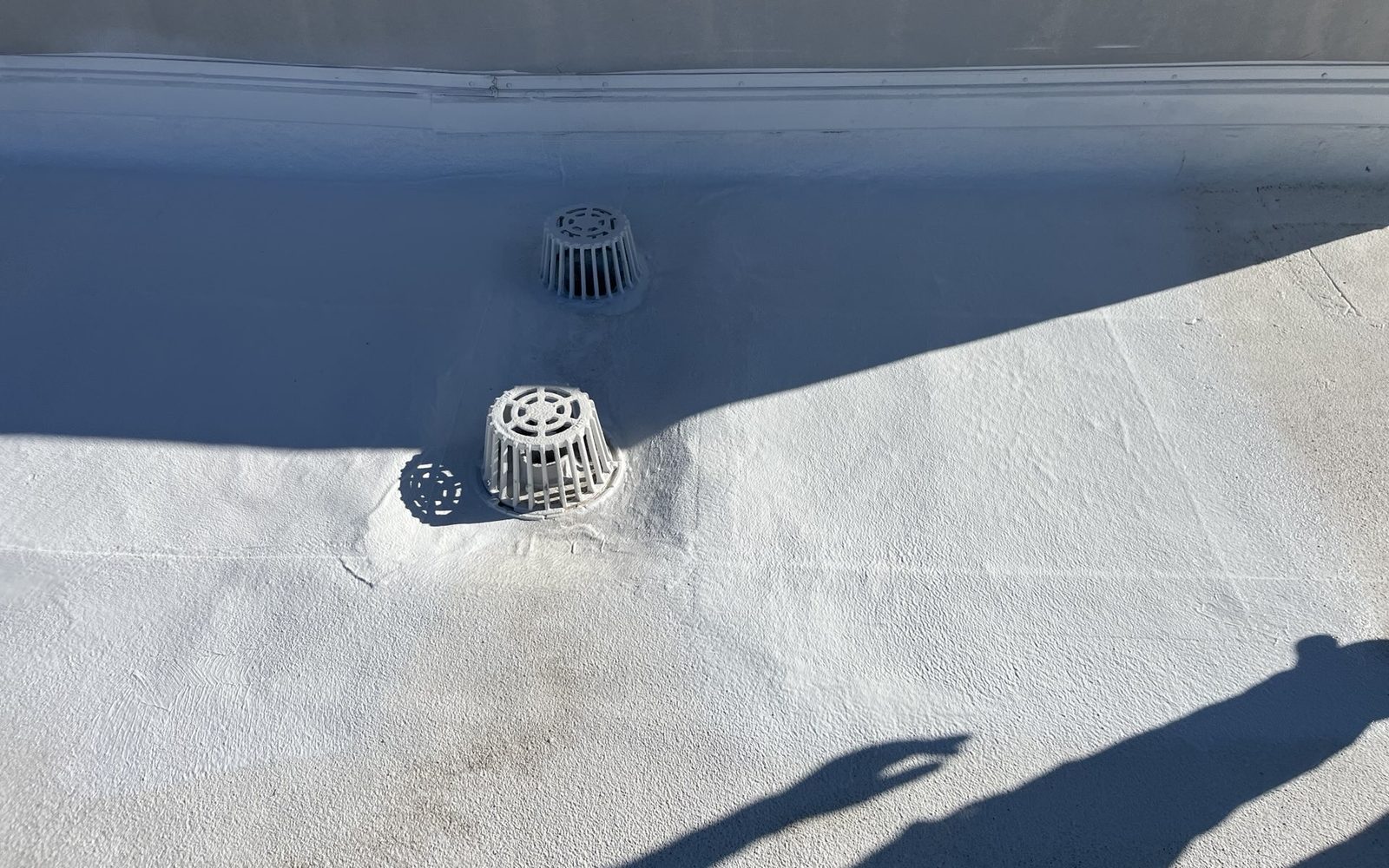
A side-by-side recap at the drains, the hardest detail on a low-slope cap sheet roof and the first place a worn one gives up.
FAQ
How do you decide whether a built-up cap sheet roof can be restored instead of torn off?
The deciding question is whether the plies underneath the cap sheet are still dry and sound. Built-up roofing is a multi-ply assembly, and what usually fails first is the granulated surfacing rather than the redundant layers below it. On this property the surface was at the end of its life after more than 15 years, with split seams, alligator cracking, and granule loss, but the plies were still serviceable. That is what made a coating restoration the correct call across about 215,000 square feet, and it is why a tear-off would have thrown away a roof that still worked.
Why remove all the walk pads before coating?
Walk pads sit on top of the roof and hide it. You cannot inspect or clean the cap sheet beneath them, you cannot bond a coating to them reliably, and the dirt and moisture they trap is exactly what you are trying to get off the roof before priming. On this job every pad on all ten buildings came out, including the pads ringing each rooftop air handling unit, and it produced enough debris to need a dedicated dump trailer. The scope allowed four crew days for that step alone.
Can tenants stay open while a coating restoration is going on?
Yes, and on this project they did. Nothing is opened up on a restoration, which is the practical advantage over a tear-off: the roof stays watertight through every stage, so there is no night-time dry-in and no exposure risk to the space below. The disruption that does reach tenants is on the roof itself, mainly wash water, masking around rooftop equipment, and coating cure times. We sequenced building by building and arranged access with property management ahead of each shift, so stores were not affected.
What drove the cost on this project?
The approved total was $485,055, which works out to $2.25 per square foot: $2.17 for the restoration and $0.08 for the manufacturer No-Dollar-Limit warranty line. Measured area is the biggest single driver on a job like this. After that it was the hand work, which does not scale down: roughly 6,200 linear feet of parapet coated one foot up, three-course detailing at every seam, penetration, and roof-to-sidewall joint, about 20,000 square feet of shingled parapet wall that needed an inch of foam before coating, silicone at the rooftop equipment that needed it, and stripping and hauling every walk pad on ten roofs.
What does it mean when the owner brings their own roof consultant?
It means our documentation and our system selection get an independent technical review, which we welcome. On this project the owner’s consultant walked the roof with us, the coating manufacturer, and the property manager, and issued a punch list that included touch-ups on all ten buildings and extending the 40-inch reinforcing fabric further at every roof drain. We scoped that work at a day and a half and completed it. The consultant then validated the punch list on a final walk covering buildings one through six, and the client accepted the work.
Have more questions? Check out our FAQ page.
Have an Aging Built-Up or Cap Sheet Roof in the Phoenix Metro?
If you manage a commercial property on built-up or modified bitumen roofing and you are not sure whether you are looking at a restoration or a replacement, request a commercial roof inspection. We will document condition building by building, tell you whether the plies are still sound enough to coat, and put the measured areas and the warranty options in writing so you can budget from real numbers.
Five Guys Roofing · (480) 892-5311 · ROC# 301077 & ROC# 301076 · fiveguysroofing.com
We do not publish addresses, property names, tenant names, or client-identifying details.
